
It Took Me 3 Years To Talk About What Happened In There
I didn’t know how quickly people could stop listening

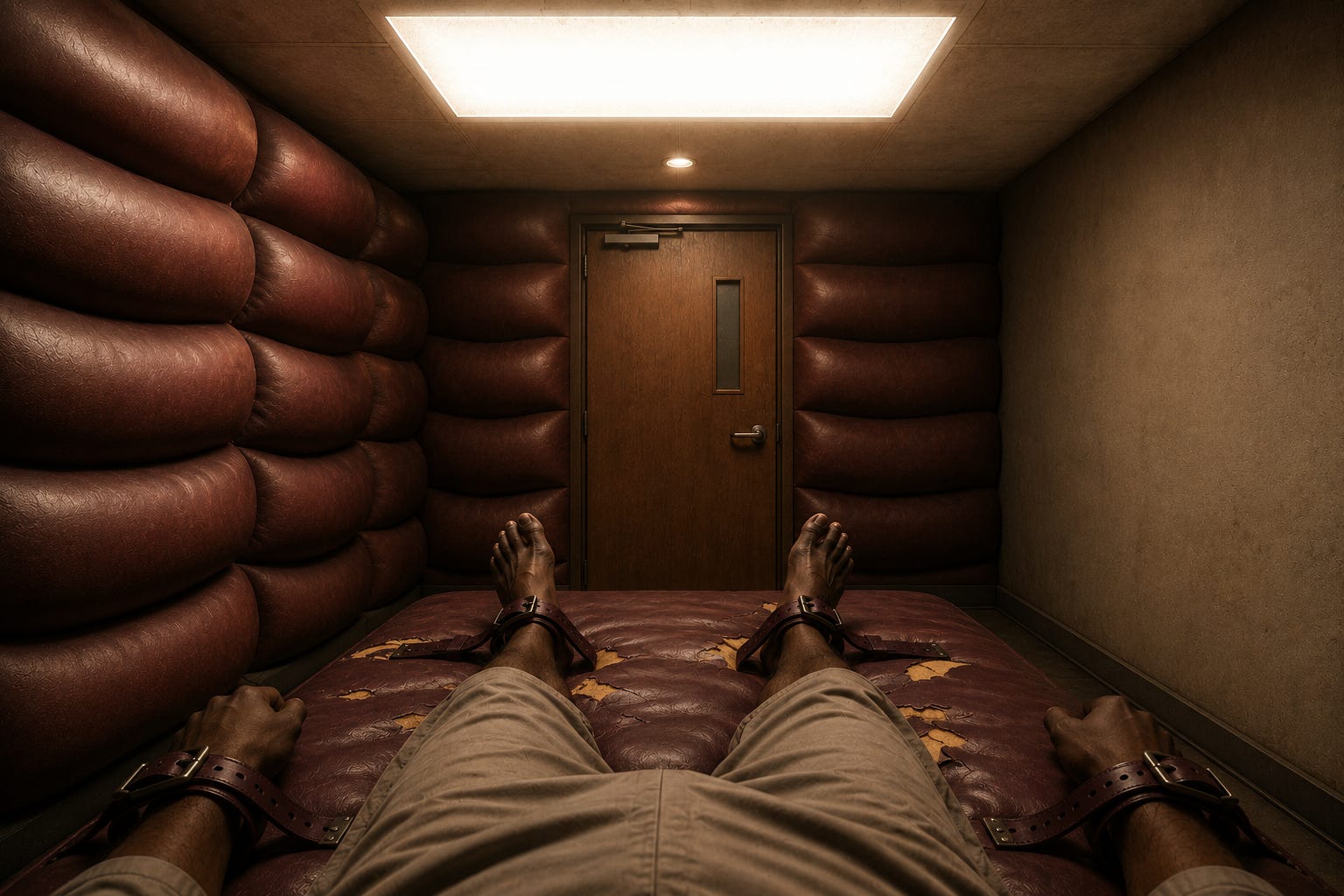
The ceiling light was bright white and glaring in my eyes. I never liked bright lights. They always made me physically uncomfortable. I could never think clearly beneath them. But this time, my body wasn’t fighting. I just lay there like that, the torn red leather scratching against my back.
I don’t know if it had been minutes or hours earlier, but four men had held me down while two of them tightened the straps around my wrists and ankles. Afterward, a nurse I recognized from my previous admission said, “Don’t worry. You won’t be here long.” His kindness felt distant, unreal. All I could think about was how long I was going to be locked up this time.
It all started 15 days before. I was sitting on the terrace of my apartment listening to a sad song when I received a call. It was one of my uncles on my father’s side whom I hadn’t talked to in years. I was hesitant to pick up the call, but I did anyway.
After a bit of small talk, he invited me over to his city to spend Pongal (a South Indian festival) with him and my cousins. I thought the trip would do me some good so I agreed.
The first day or two was okay. But I was getting tired of the same conversations I always seemed to stand outside of. I was bored, irritated, and lonely. So, I did what I usually did when I felt that way. I went out for a walk and opened Grindr.
I’m not proud of it, but all I needed was to cool off and be around someone that was not my family. I texted this guy who said he had weed. I hated smoking but I said he could if he wanted to. I asked him to come over to the entrance of the apartment complex I was in.
I gave him a brief hug. Maybe it lasted an extra 2 seconds. When I let go, out of nowhere, my uncle stepped directly into my face. In a split second, I found myself being brutally interrogated. “Who is this guy? Why are you hugging him? How do you even know him? How did he even know where to find you? It’s after seven o’clock at night. What were you planning on doing?” I couldn’t think clearly enough to lie my way out of it.
I can’t recall what happened with that guy but I do remember walking back to his apartment with him tailing me at a ten-foot distance. What followed was an hour of him yelling at everyone in the living room, while my father was letting out sighs of disgust. I just stood there by the door to the spare room, as the one thing I was dreading my whole life was happening right in front of me in the worst way possible. This was not how I imagined I’d come out.
I remember locking myself in the spare room and crying myself to sleep. I later found that they had locked the door from the outside too. The next day, my parents and I got on a train home. I holed myself up in my room for the rest of the week.
The following week, I got tested for HIV. I thought it would give me one good thing to hold onto. I got a call the next day saying that I had to come down to the HQ to collect my test results. I always got the results online, so I had to ask why. I still remember what the guy on the phone said. “When they ask you to come, it’s usually because it’s positive.”
I was beginning to come to terms with my diagnosis in the subsequent days. I told myself all I had to do was nothing and wait for the worst to happen.
One day, out of the blue, my father was forcing me to talk to some random lady on the phone. It turned out to be a counselor of sorts to help me process this whole thing. The woman sounded nice, but her words just went over my head because I didn’t want any more “help.” I was done.
A week from then, I was due to meet my psychiatrist for a review. After everything that had happened over the past few weeks, I did not want my parents there. So I decided to go alone.
In the hospital, it is routine for you to meet a psychologist who does a preliminary assessment before meeting the psychiatrist. When I went to meet the psychologist, I was glad to see a friendly face. I knew her from the last time I was admitted.
I can’t recall the details, but the meeting with her did not go well. I felt attacked instead of heard. I didn’t feel safe enough to say anything. I just wanted to get the hell out of that room. And she let me.
I wanted to pay off all the fees before I went in to see the psychiatrist. To my surprise, the receptionist asked me to pay double the usual fee. When I asked why, I got an unusual reason. From what I understood, the psychologist had spoken to my parents over the phone after my session with her, which was why I was being charged double.
I was furious. I wanted to immediately confront my parents about how long she’d been talking to them behind my back. So I asked the receptionist to cancel my appointment with the psychiatrist.
I was halfway down the staircase when I saw five men in dark blue shirts and black pants waiting at the end, staring up at me, calling me out. I instantly knew what was about to happen. Nevertheless, I stood there and let them talk.
I asked why they were there waiting for me. They told me the psychiatrist wanted to see me for five minutes before I left. I didn’t want to do that and said so. I even explained that I’d come back at a different time, because right then all I wanted to do was go home and talk to my parents.
The next thing I remember was being carried by my limbs to the second floor’s “de-escalation room” with the red leather bed and padded walls, and being strapped down.
I didn’t even fight. I just let them do what they wanted. Seeing those men in the stairwell gave me déjà vu. I was prepared for this. At least my body was. I was too exhausted to resist. It just felt easier to comply.
Next morning, I was sent to go see the psychologist for in-patients. I half expected to find the same one who saw me the previous night. She said a couple things. I didn’t listen to a word. But after a minute, she asked me if I wanted to say something. I gave her the finger.
On the same day, I was handed a bunch of forms and asked to sign. I surprised myself when I said no. That’s when they started dangling my future freedom in front of me like a carrot. I was asked to “cooperate”—a word which I’ve now come to hate—and that if I didn’t, I wasn’t getting out of there anytime soon. Refusing to sign became the only form of protest I had left. By then, my rage felt mostly symbolic.
Over the next couple of days, I had a lot of time to think. I was getting tired of thinking that I actually had a shot at winning through my minor acts of protest. But I realized that there was no winning move left. Every emotional reaction only seemed to confirm what they already believed about me.
I was prescribed r-TMS treatment. It happened in a small room on the open terrace of the hospital building. I had to go in and sit still on a recliner while the machine tapped against my skull for twenty-five minutes.
While I was waiting outside on a chair, I asked the ward’s helper guy who accompanied me, “Will the doctor really not see me if I don’t sign the forms?” He calmly replied, “He won’t.” It took me a minute to take that in. And then I gave in. I asked for the forms and signed wherever he pointed. Fighting no longer felt useful.
The whole time I was in there, I didn’t speak to my parents. Of course, I blamed them for locking me up in there. The psychologist told me they were calling to check in but I didn’t care. I was abandoned in a place against my will and they could’ve gotten me out. At the very least, I wanted someone to stop it. But no one came.
My whole life with them played in my head. I’d always been physically comfortable with every need met. But emotionally, that was never the case. And this time wasn’t any different. For the first time in my life, I realized that people could support my survival while never trying to understand how I feel.
I was helpless in there and I hated it. So after I got out, I threw myself into so many things. I bought a second-hand violin from the upstairs neighbor and started learning to play it by myself from YouTube. I signed up for German classes. I learned to solve the Rubik’s cube. I joined a gym for the first time. I wanted to prove to myself that I could do anything I set my mind to. That I could make choices and follow through.
Since then, I observed something common across almost every environment I’ve been in. Once you’re labeled “unstable,” even harmless emotions start feeling dangerous to express. People responded better when I was easier to manage.
It took me three years to finally get the courage to talk about this. Multiple emotions coexist when I think about this whole mess. Grief, gratitude, numbness. Even now, I still don’t know whether I healed or simply adapted.
I don’t know if talking about this changes anything. But pretending certain things never happened rarely does.
—Karthik